
Disparity in Legal Representation in Eviction Court
If it is your first time visiting the site, be sure to read the Data Availability and Working with the Data pages.
To see the data visualizations on your phone, rotate your device to landscape (horizontal).
The crosstab tables on this page are easiest to see on a computer (desktop, laptop, or monitor).
Visit the Data Tables page to view or download the data by year.
Updated on: September 15, 2026
Court proceedings are often depicted as an adversarial event between opposing lawyers, on behalf of their clients. Trials are commonly thought of as a crucial step in the legal process, where evidence is presented and a judge or jury deliberates the merits of the case and the defense. Eviction lawsuits rarely play out this way. In Oregon, less than 10% of the eviction cases that are filed go to trial. Instead, the vast majority of eviction cases end with a judgement of eviction by default, are dismissed by the plaintiff, or are settled without trial using a court-enforced stipulated agreement. Understanding how and when to proceed to trial or pursue one of the alternate paths benefits from legal expertise, which is why having an attorney represent you in eviction proceedings is beneficial - to both tenants and landlords. An attorney provides their client with legal knowledge and procedural experiences, which is an advantage in these complex and high-speed legal proceedings. Research shows that when tenants have access to legal representation they are less likely to have a judgment of eviction issued against them and are subject to lower monetary judgements and court fees (Cassidy and Currie 2023).
However, because eviction cases are civil cases, as opposed to criminal cases, neither side is provided a lawyer in court. However, a growing number of cities and states are implementing programs to increase legal representation for tenants or codifying “right to counsel” ordinances that guarantee legal representation for tenants in court. Reporting from those jurisdictions and the research literature both support the conclusion that providing tenants has an impact on reducing eviction and displacement. Expanding access to legal representation for tenants can reduce default judgments, support tenants’ ability to negotiate better stipulated agreements, ensure tenants are able to fully participate in their hearings and trials, mount counterclaims, and defend a tenant at trial.
Currently, there is no Right to Counsel policy or program anywhere in Oregon. If a landlord wants to be represented by an attorney in an eviction case, they have to hire an attorney. They can also be represented in court by a professional who handles their case against the tenant, such as a property manager, or third-party agent. More information on third-party agents available further down on this page.
In addition to the advantages of having a legal expert represent you in court offers, having an attorney, or legal representative, also relieves the client from the requirement of having to attend the court hearings themselves. If either party is not present for a court hearing, they forfeit the case. If the landlord, or their legal representative, fails to appear in court for a hearing the case is dismissed. This rarely happens. If the defendant fails to appear in court, a judgement of eviction is issued against them by default. Between 2020 and 2025, 15% of the eviction cases filed in Oregon ended in default judgment of eviction because the tenant was unable to attend their court hearing at the date and time it was scheduled.
Tenants can also hire an attorney, though rarely can afford to. In some parts of the state, legal advice and legal representation are provided to tenants for free, though not all tenants are eligible for these limited programs. In 2024, the Oregon State Bar implemented a new Professional Paralegal program that allows paralegals to represent tenants in eviction court. However, the program does not appear to have been widely adopted statewide.
Disparity Between Landlords and Tenants in Legal Representation by an Attorney

In any case, either the landlord or the tenant might be represented by an attorney, or both parties, or neither.
Each eviction case falls into one of four possible representation categories:
Neither party has legal representation.
The tenant has legal representation, but the landlord does not.
The landlord has legal representation, but the tenant does not.
Both the tenant and landlord have legal representation.
The crosstabs below display how many cases fall into each category. Use the filters at the top of the tables to sort by time and location. Based on the eviction data availability, counties with lower visibility (i.e., no, low, or partial visibility) were excluded from the county-level table. For the statewide table, all eviction cases filed in the Oregon Circuit Courts were included. These tables only include representation by an attorney that is recorded in the case record. The crosstab tables on this page are easiest to see on a computer (desktop, laptop, or monitor).


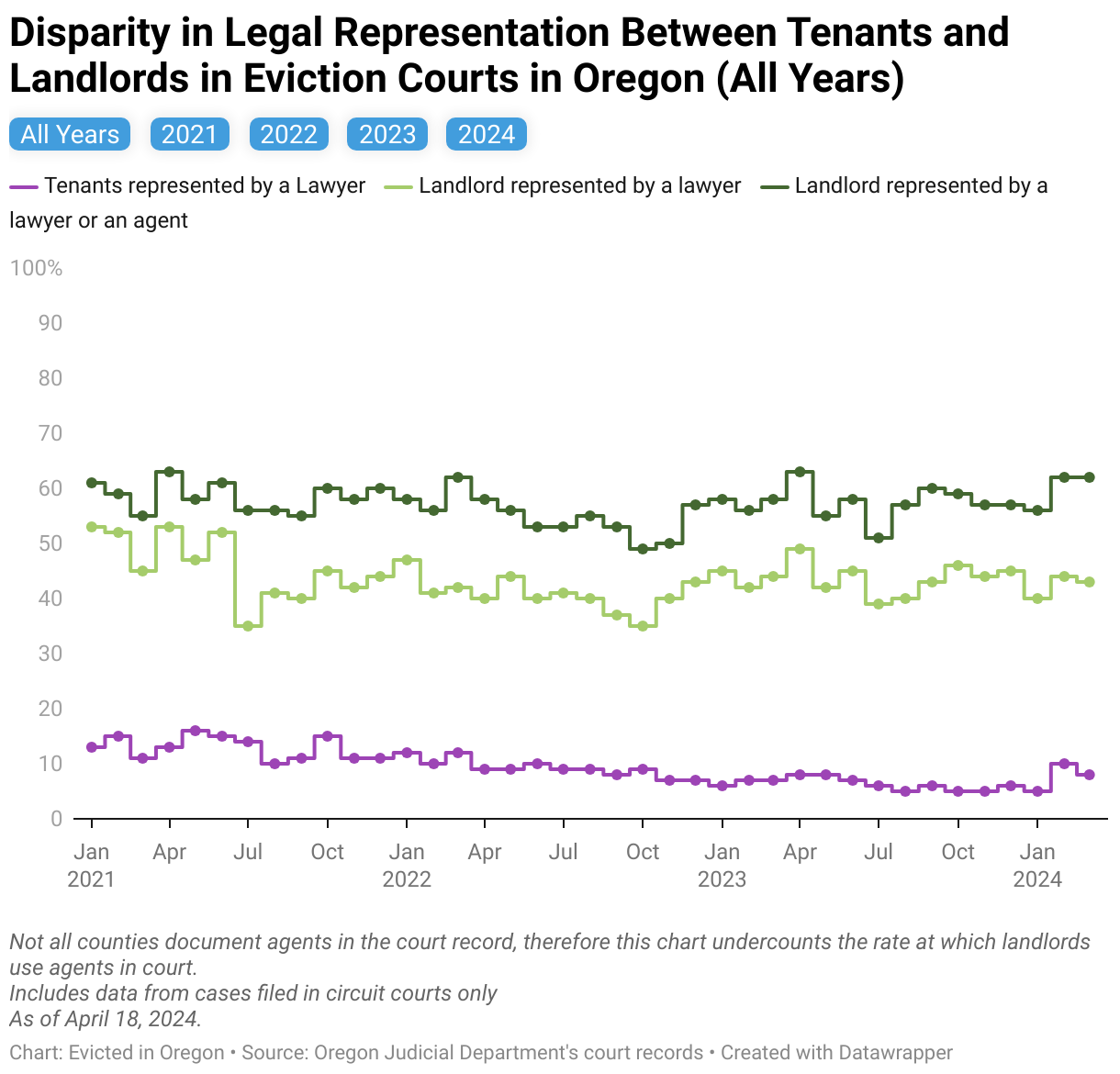
From 2020 to 2025, 9% of tenants in Oregon were represented by an attorney in eviction court. Over the same period, 43% of landlords were represented by an attorney in eviction court. Additional landlords may have had professional representation, without having an attorney.
In Oregon, landlords are allowed to be represented in landlord-tenant court by an agent. ORS Chapter 90 defines Landlord Agent as “a person who has oral or written authority, either express or implied, to act for or on behalf of a landlord.” In eviction court, this can include a representative from the company that owns the property, from the company that manages the property, or a third-party agent who acts as an “eviction specialist” that the landlord hires to manage the eviction process. Agents can represent landlords at the first appearance and during negotiations with the tenant, but cannot represent the landlord at trial. If a case moves to trial, the agent is replaced either by the landlord or an attorney hired by the landlord. There is no equivalent agent for tenants.
Disparity Between Landlords and Tenants in Legal Representation, Including Landlords Represented by a Third-Party Agent
Statewide
When we include the professional landlord agent as part of landlord representation, between 2020 and 2025 statewide landlord representation rises from 44% to 59%. However, not every county in Oregon records representation by third-party agents in eviction court. Therefore, the reported statewide landlord representation rate is less than the true rate.
Multnomah County
Multnomah County reliably records when a third-party agent represents a landlord in eviction proceedings. The crosstab below displays the rates of representation, including third-party agents, for landlords and tenants in Multnomah county. Between 2020 and 2025, 86% of landlords in Multnomah County were represented by either an attorney or a third-party agent.
